
Short answer: kit kat tiles are slim rectangular finger mosaics, supplied on a mesh sheet and named after the fingers of the chocolate bar. This site has three: a white finger mosaic at 12.8 × 95 mm, and two strip mosaics at 20 × 145 mm on a 296 × 299 mm sheet. The number that decides the look is joint length: about 88.7 m per square metre for the 12.8 × 95 mm finger and 56.9 m for the 20 × 145 mm strip, against 16.7 m for a 75 × 300 mm subway tile. The grout draws most of the picture.

| Product on this site | Piece size | Sheet size | Pieces per m² (no joint) | Joint length per m² | Finish / material recorded |
|---|---|---|---|---|---|
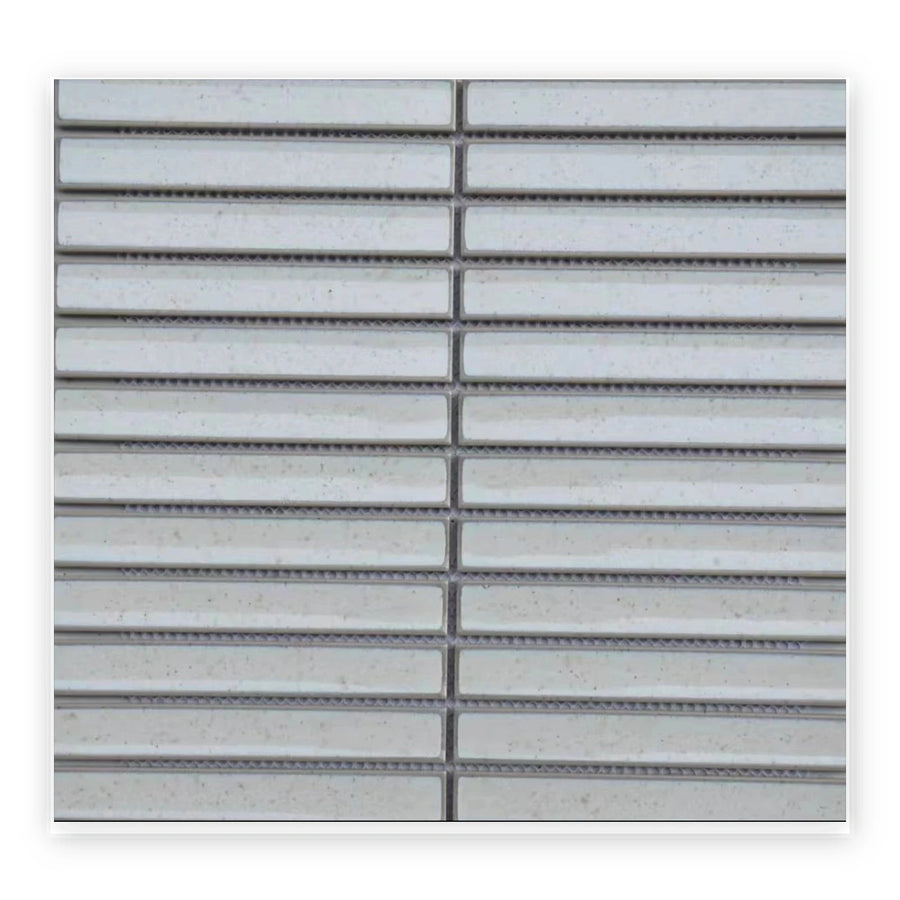
| Studio White Finger Mosaic Tile | 12.8 × 95 mm | Not recorded; the product page says to check the current size | 822 | 88.7 m | Gloss / Porcelain, white |
| Carrara White Strip Mosaic Tile | 20 × 145 mm | 296 × 299 mm | 345 pieces, 11.3 sheets | 56.9 m | Gloss / Porcelain, white |
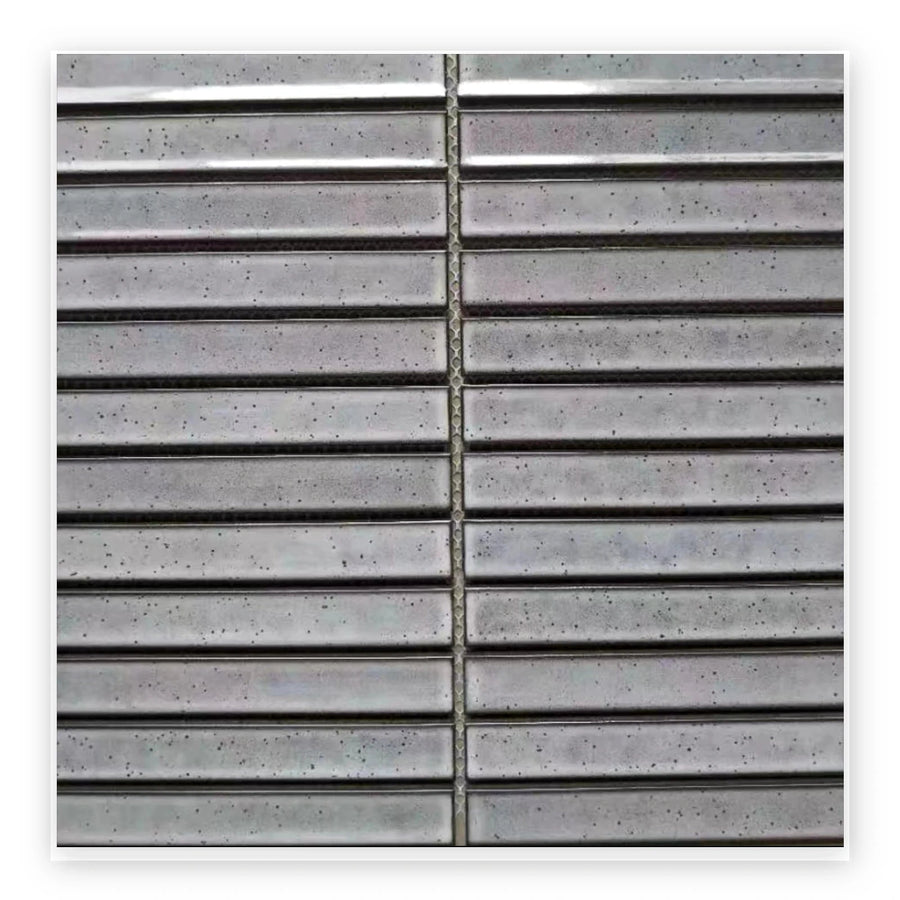
| Studio Graphite Strip Mosaic Tile | 20 × 145 mm | 296 × 299 mm | 345 pieces, 11.3 sheets | 56.9 m | Gloss / Porcelain, grey |
| Carrara Stack Mosaic Tile (the wider relative) | 36 × 150 mm bars | 305 × 305 mm | 185 bars, 10.7 sheets | 34.4 m | Soft polished / Natural marble, white |
1. What the name means
Kit kat is the trade nickname used in Australia for a thin finger mosaic; the pieces look like the fingers of the chocolate bar. The same tile is also sold as a finger mosaic, a strip mosaic or a stick mosaic. On this site the product names use finger and strip, and the collection uses the nickname. Nothing about the tile changes with the name: it is the piece size and the sheet size on the product page that tell you what you are buying.
2. Fingers against strips: 12.8 × 95 and 20 × 145
The two formats here have almost the same proportion, about 7.4 to 1 for the finger and 7.3 to 1 for the strip, at two different scales. That is why they read as the same idea from across a room and differently up close. A square metre holds about 822 fingers or 345 strips, and the joint length follows: 88.7 m against 56.9 m. The finger has more than five times the joint of a 75 × 300 mm subway tile in the same area.
3. Vertical stack, the reading most people mean
The sheet arrives with the pieces already set in a straight stacked grid, so the first layout decision is only which way up the sheet goes. Stood upright, a 600 mm splashback is about 6.3 fingers high at 95 mm, or 4.1 strips at 145 mm, before joints. The rhythm is vertical, the highlights on a gloss face fall as short upright dashes, and the wall reads taller than it is.
4. Horizontal, and why the sheet decides
Turn the sheet a quarter turn and the same grid runs along the wall. What you cannot do from the sheet is a brick offset: the spacing inside a sheet is fixed on the mesh in the factory, so an offset means the tiler cutting sheets into single rows and resetting them. The joint where two sheets meet has to match the joints inside them, or the sheet edges draw a faint grid over the surface that grout will not hide.
5. The grout does most of the work
A 1.8 m² splashback, 3 m long and 600 mm high, carries about 160 m of joint in the 12.8 × 95 mm finger, 102 m in the 20 × 145 mm strip and 30 m in a 75 × 300 mm subway tile. At that density the grout colour is the design: a tone close to the tile turns the wall into one textured surface, a darker tone turns every finger into a drawn line. Ask the tiler for a sample joint on one sheet before the wall goes up, and keep the grout name and colour code with the order.
6. Where the field stops
A stacked finger field ends on a straight line at the sheet edge, so a top edge or a trim finishes cleanly. The width is the harder edge: a run rarely lands on a whole finger, and a cut piece shows more on a 12.8 mm finger than on a wide tile. Set out so the cut column lands in the corner that is seen least, and decide before the first sheet goes up whether the field ends at a trim, a return or an open edge.
7. Count by the sheet, or by the piece when the sheet is not recorded
For the two strip mosaics the sheet is recorded at 296 × 299 mm, so quantity is net area × 11.3 sheets per m², then the cutting allowance your tiler confirms. For the finger mosaic the product page records the piece size and asks you to check the current sheet size, so count only after that check. How to measure a tiling project sets out the method for both.
8. Colour and finish on this site
All three are gloss porcelain: two white, one graphite. The natural marble stack mosaic is the wider, soft-polished relative at 36 × 150 mm, with 34.4 m of joint per square metre. The whites sit under White tiles, the graphite under Grey tiles, and all four under Gloss finish tiles or Soft polished finish tiles by face.
Questions people ask
What size are kit kat tiles?
On this site, 12.8 × 95 mm and 20 × 145 mm. Elsewhere the nickname covers a range of slim fingers; the piece size on the product page is the fact to compare.
Are kit kat tiles the same as finger tiles?
Yes. Kit kat is the nickname, finger, strip and stick are the descriptive names, and they all describe a thin rectangular mosaic piece on a mesh sheet.
How many kit kat tiles per square metre?
About 822 pieces at 12.8 × 95 mm and 345 at 20 × 145 mm, nominal, with no joint. The strip sheets work out at about 11.3 sheets per square metre.
Should I pick the grout from the chart?
No. At 88.7 m of joint per square metre the grout is close to a fifth of the wall at a 2 mm joint, so choose it from a dried sample joint between two of your tiles. Grout colour: why a dried sample joint beats the chart explains why the chart and the wet colour both mislead.
Where these numbers come from
Piece sizes, sheet sizes, finishes and materials were read from the product pages on 5 September 2026. Pieces per square metre are nominal counts with no joint; joint length is the total edge length in one square metre of surface. All four sheets are listed under Mosaic tiles. Related guides: Kitchen splashback tiles: 9 formats compared, Subway tile layouts: 8 patterns and What a tiled surface asks you to clean.