
Short answer: the splashback decision is three recorded facts, not a style label. Face size sets how many joints you will see, finish sets how the wall handles light, and material is whatever the product page records. The table compares nine formats on this site by those three facts; the sections below say what each one does to a 1.8 m² splashback (a 3 m run at 600 mm high).

| # | Format | Face or sheet size | Pieces per m² (no joint) | Joint length per m² | Finishes recorded here |
|---|---|---|---|---|---|
| 1 | Subway, flat face | 75 × 300 mm | 44.4 tiles | 16.7 m | Gloss; one product records no finish |
| 2 | Subway, wave face | 75 × 300 mm | 44.4 tiles | 16.7 m | Gloss |
| 3 | Wide subway | 100 × 300 mm | 33.3 tiles | 13.3 m | Gloss, Matt |
| 4 | Rectified wall tile | 300 × 600 mm | 5.6 tiles | 5.0 m | Gloss |
| 5 | Strip mosaic | 20 × 145 mm chips, 296 × 299 mm sheet | 11.3 sheets | 56.9 m | Gloss |
| 6 | Herringbone mosaic | 21.5 × 71.5 mm chips, 316 × 277 mm sheet | 11.4 sheets | 60.5 m | Gloss, Matt |
| 7 | Hexagon mosaic | 282 × 325 mm sheet; 250 × 290 mm sheet (70 mm face) | 10.9 / 13.8 sheets | 28.6 m at a 70 mm face | Matt; Soft polished |
| 8 | Stacked-bar mosaic | 36 × 150 mm bars, 305 × 305 mm sheet | 10.7 sheets | 34.4 m | Soft polished |
| 9 | Large format | 600 × 600 mm; 600 × 1200 mm | 2.8 / 1.4 tiles | 3.3 / 2.5 m | Matt, Honed, Polished, Soft polished, Rough |
1. Subway tile, flat face, 75 × 300 mm
The reference format. A 1.8 m² splashback takes about 80 tiles before cuts and shows 30.0 m of joint. On this site: Studio Flat Subway Tile, Studio Greige Subway Tile, Studio Charcoal Subway Tile and Studio Ink Subway Tile. The layout question is separate; see Subway tile layouts: 8 patterns.
2. Subway tile, wave face, 75 × 300 mm
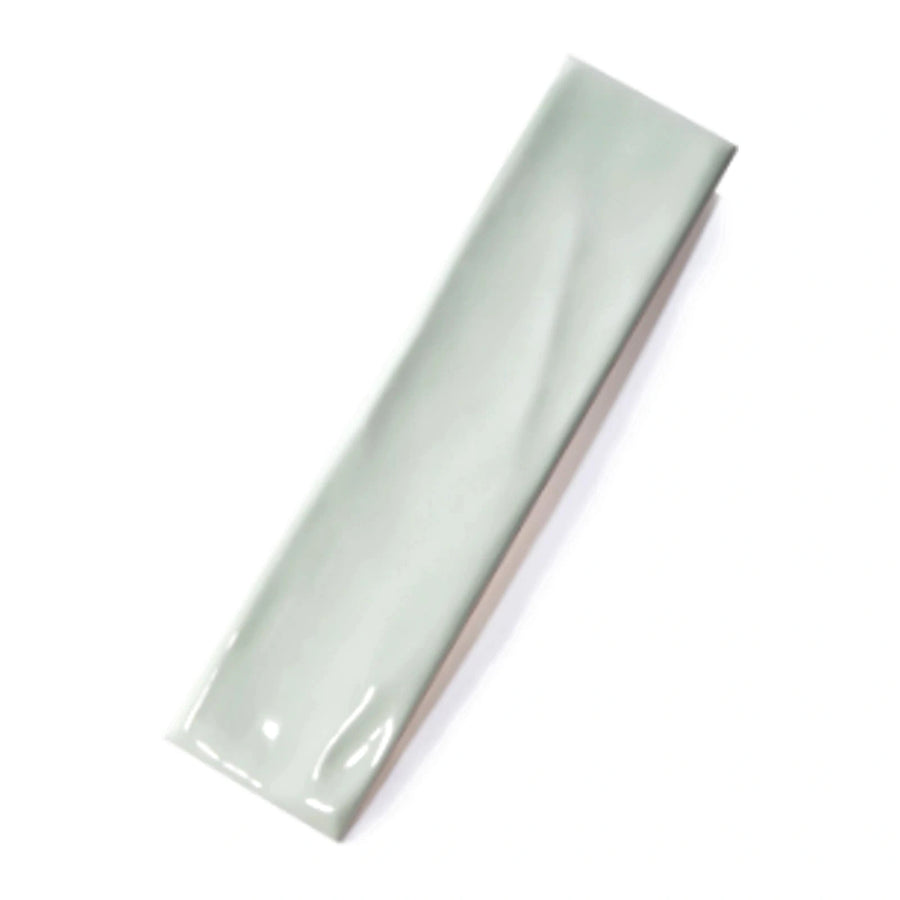
Same count, same joint length, different surface: the face undulates, so a gloss glaze breaks into highlights instead of one flat reflection. Studio Wave Subway Tile, Studio Crest Wave Subway Tile, Studio Cloud Wave Subway Tile, Studio Sage Wave Subway Tile and Studio Ink Wave Subway Tile are the five wave faces recorded here.
3. Wide subway, 100 × 300 mm
Going from 75 to 100 mm high drops the count to about 60 tiles for the same splashback and cuts joint length by a fifth, from 16.7 to 13.3 m per m². This is the format to pick when the aim is a calmer wall with fewer lines. Two finishes are recorded: Studio Chalk Subway Tile in gloss and Studio Linen Subway Tile in matt.
4. Rectified wall tile, 300 × 600 mm
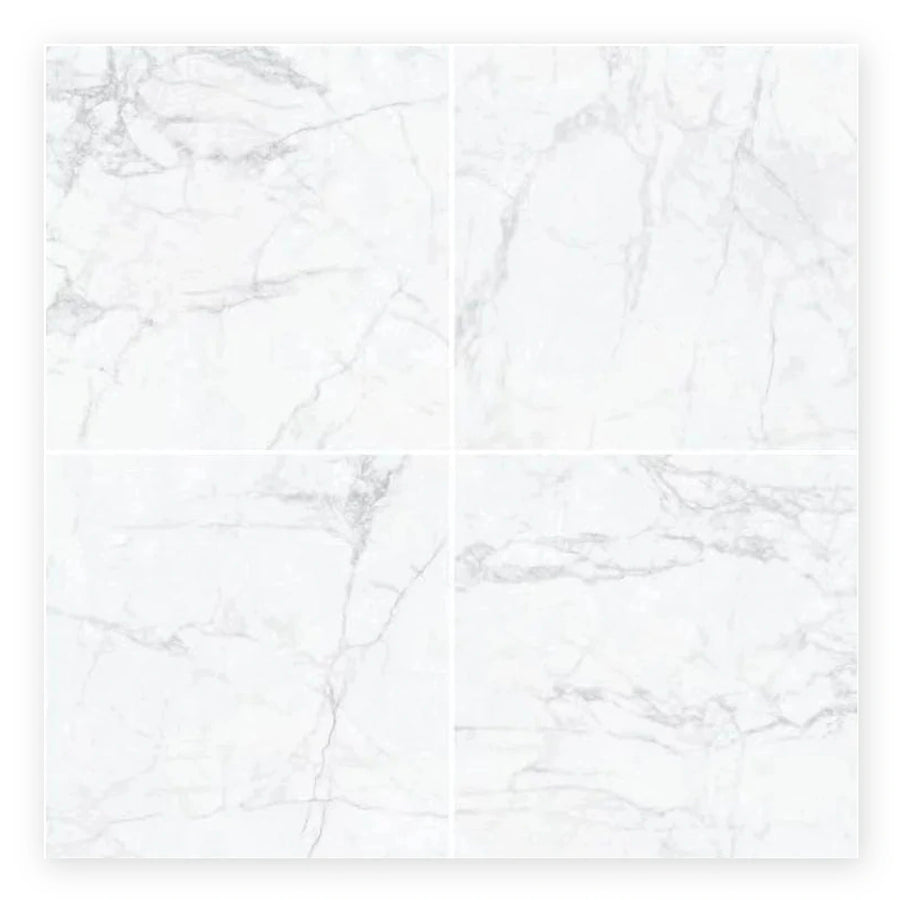
A single 300 × 600 mm tile is 600 mm high, so a 600 mm splashback is one course with no horizontal joint at all. About 5.6 tiles per m², 5.0 m of joint. Rectified means the edges are cut square after firing, which is what allows a narrow joint. Studio Pure White Wall Tile is the product recorded in this format.
5. Strip mosaic, 20 × 145 mm chips
The other end of the scale. A 20 × 145 mm chip carries about 57 m of joint per square metre, three and a half times a 75 × 300 subway tile, so the grout colour decides the look more than the chip does. Two porcelain sheets are recorded: Carrara White Strip Mosaic Tile and Studio Graphite Strip Mosaic Tile, both gloss.
6. Herringbone mosaic sheet
The herringbone pattern arrives pre-set on a 316 × 277 mm mesh, so the tiler lays sheets, not individual pieces. Studio White Herringbone Mosaic Tile is glazed gloss; Carrara Herringbone Mosaic Tile is a Carrara-inspired ceramic in matt. Both record a 21.5 × 71.5 mm piece, which works out at about 60.5 m of joint per square metre.
7. Hexagon mosaic sheet
Two sheets: Carrara Hexagon Mosaic Tile, a Carrara-inspired ceramic in matt, and Carrara Large Hexagon Mosaic Tile, natural marble at a 70 mm face and soft polished. The seven layout options are in Kitchen hexagon tiles: 7 layout ideas.
8. Stacked-bar mosaic
Carrara Stack Mosaic Tile sets 36 × 150 mm natural marble bars in straight courses on a 305 × 305 mm sheet, about 10.7 sheets per m². The look is a linear wall without the cutting that a bar-by-bar layout would need.
9. Large format, 600 × 600 mm and 600 × 1200 mm
Large format on a splashback is the fewest-joints option: 3.3 m per m² at 600 × 600 and 2.5 m at 600 × 1200, against 16.7 m for subway. A 600 × 1200 tile laid horizontally covers a 600 mm splashback in one course, so the joints are vertical only, one every 1.2 m. The looks recorded in these formats are listed under Large format tiles; sizes and finish options are on each product page.
Questions people ask
Which size tile is best for a kitchen splashback?
There is no best; there is a joint count you are choosing. Per square metre: 56.9 m of joint for 20 × 145 mm chips, 16.7 m for 75 × 300, 13.3 m for 100 × 300, 5.0 m for 300 × 600, 2.5 m for 600 × 1200. Pick the line density you want to look at.
Gloss or matt behind the cooktop?
Gloss returns light as reflections, matt diffuses it. That is the difference this site records. Cleaning and heat behaviour are not recorded on the product pages and are questions for the installer and the manufacturer's documentation.
How many tiles for a 3 m splashback?
At 600 mm high, 1.8 m² net. About 80 tiles at 75 × 300 mm, 60 at 100 × 300 mm, 10 at 300 × 600 mm, or 20 strip-mosaic sheets, all before the cutting allowance your tiler confirms. Subtract windows and power points from the net area first.
Where should the splashback stop?
At one of four lines: the underside of the overhead cupboard, the window head, the full wall height, or a trim line at the return. Formats that are 600 mm in one dimension, 300 × 600 mm on end or 600 × 1200 mm laid flat, meet a 600 mm cupboard line in one course with no cut; a stepped mosaic edge, hexagon or fish scale, needs a straight cut or a trim to stop cleanly. Decide the stop before set-out, because it fixes where the cuts land, and put it in the quote: Supplying your own tiles: what a tiling quote should list.
Where these numbers come from
Face and sheet sizes, finishes and materials were read from the product pages on 2 September 2026. Pieces per square metre are nominal counts with no joint; joint length is the total edge length in one square metre. Every product above sits in Kitchen tiles. Related: How to compare tile scale and The thirteen ways this range writes a finish.