
Short answer: a hexagon mosaic in a kitchen is almost always a sheet, not a single tile. On this site the two hexagon products are supplied as 282 × 325 mm and 250 × 290 mm sheets, which works out at about 10.9 and 13.8 sheets per square metre. The seven ideas below are ways to use that sheet, and each one comes with the number you need to count it.

| Product on this site | Sheet size | Sheets per m² (no joint) | Finish recorded | Material recorded |
|---|---|---|---|---|
| Carrara Hexagon Mosaic Tile | 282 × 325 mm | 10.9 | Matt | Ceramic |
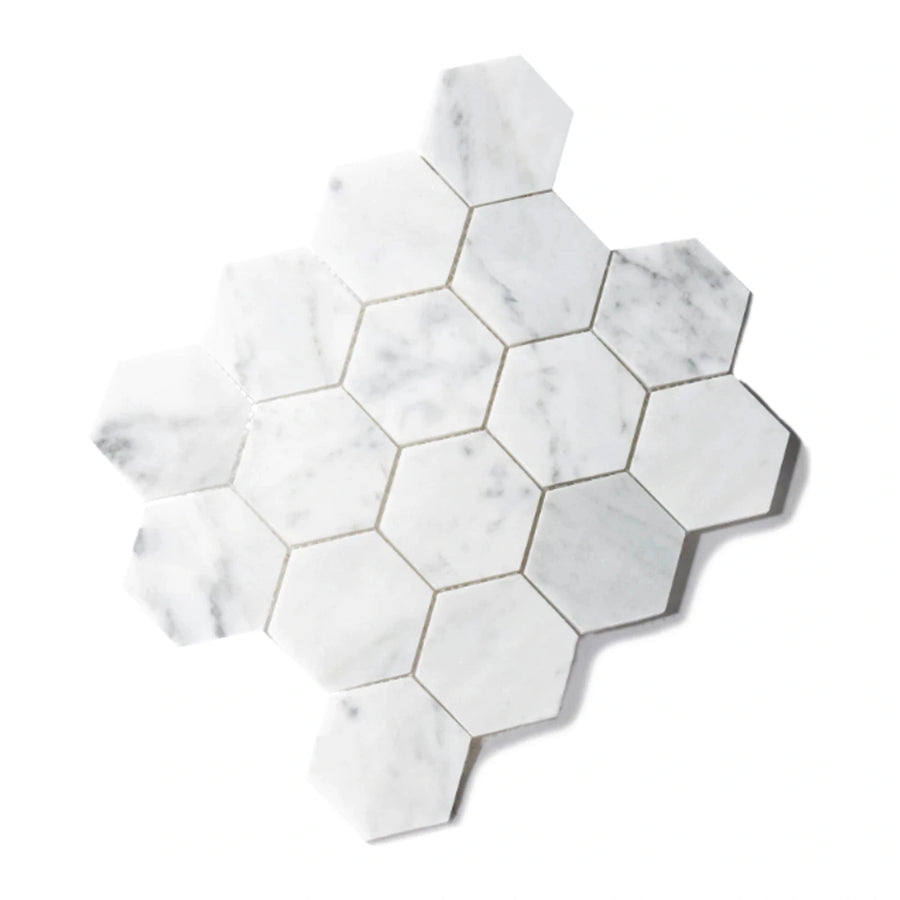
| Carrara Large Hexagon Mosaic Tile | 250 × 290 mm (70 mm face) | 13.8 | Soft polished | Natural marble |
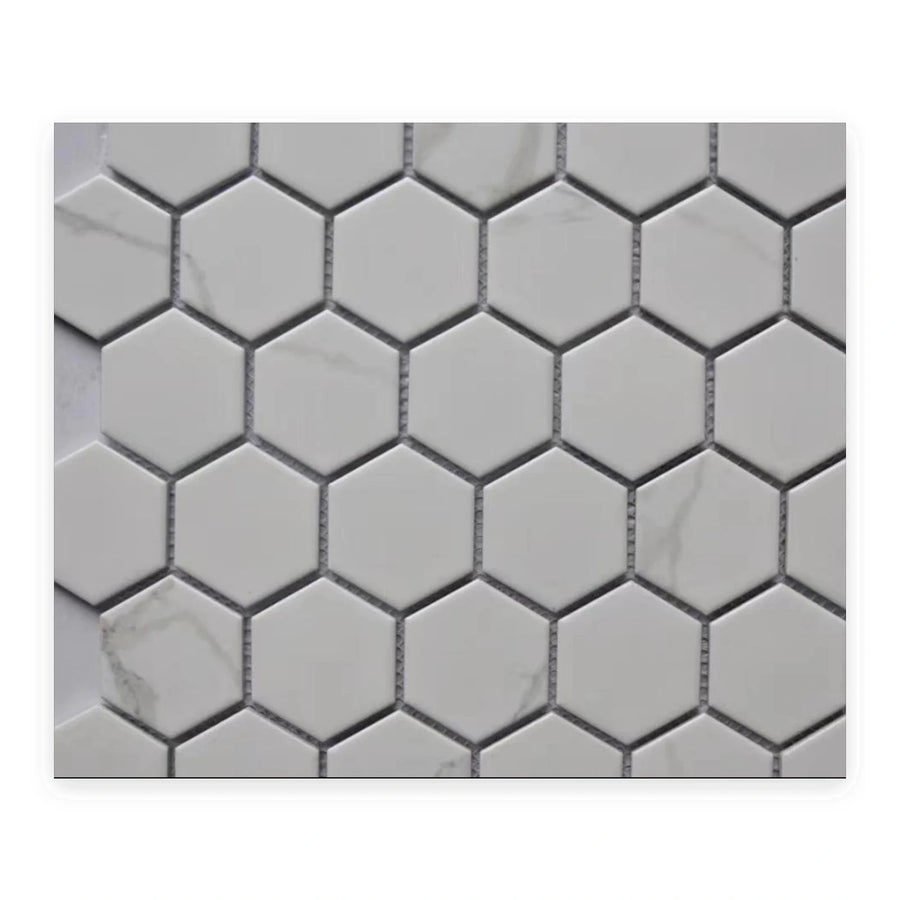
1. A full splashback in one sheet pattern
The simplest use is also the most common: the whole splashback, benchtop to overhead cupboard, in one hexagon sheet. For a 3 m run at 600 mm high that is 1.8 m², or about 20 sheets of the 282 × 325 mm product before cuts. Order the count from the net area of the wall, not from a photograph; How to measure a tiling project sets out the method.
2. A hexagon band between benchtop and cupboard
Where the wall above the splashback is painted, the hexagon field becomes a band. Laid with the 282 mm dimension running along the wall, one row of the ceramic sheet covers about 3.5 sheets per running metre, and two rows reach roughly 650 mm high. The top edge of a hexagon field is stepped by nature; decide early whether that step stays visible or is cut to a straight line behind a trim.
3. The larger hexagon for fewer, bolder pieces
Carrara Large Hexagon Mosaic Tile is the natural marble option at a 70 mm face, so the veining reads across each piece rather than being lost in a small chip. A 70 mm hexagon carries about 28.6 m of joint per square metre, against 16.7 m for a 75 × 300 mm subway tile. More joint means more grout on show, which is the next decision.
4. Grout colour is the design decision
With 28.6 m of joint in every square metre, the grout is a visible line drawing, not a background. A grout close to the tile colour makes the field read as one surface; a contrasting grout makes every hexagon read on its own. Ask the tiler for a sample joint on one sheet before the whole wall goes up, and keep the grout name and colour code with the order record.
5. Where hexagon meets subway
A hexagon field often ends against another tile, most often a subway tile on the return wall. There are two honest ways to finish that line: cut the hexagons straight along the junction, or let the stepped edge run and fill behind it with the second tile. Both are legitimate; the second needs more cutting of the subway tile. The subway range is listed under Subway tiles.
6. Count sheets, not hexagons
A mosaic sheet is a mesh-backed panel, and the product page records the sheet size, not the number of hexagons on it. Quantity is therefore counted in sheets: net area × sheets per m², then an allowance for cuts that your tiler confirms. The joints inside a sheet are fixed by the mesh; the joints between sheets are set by the installer and should match them.
7. If the question is really about the floor
Many people searching for kitchen hexagon tiles mean the floor. This page only covers walls and splashbacks, because a floor raises questions the product page has to answer first: the recorded material, the slip information if any is recorded, and the thickness. What to confirm before choosing lists what each product page states and what it leaves blank.
Questions people ask
How many hexagon sheets do I need per square metre?
About 10.9 sheets of the 282 × 325 mm ceramic sheet, or about 13.8 of the 250 × 290 mm natural marble sheet, before cuts. Multiply by the net wall area.
What size are the hexagons?
The natural marble sheet records a 70 mm face. The ceramic sheet records its sheet size only; count it by the sheet.
What grout joint width should I use?
Inside a sheet the joint is fixed by the mesh. Between sheets, match it; the installer sets the exact width. This site does not record a joint width for either product.
Should I pick the grout from the chart?
No. A 70 mm hexagon carries about 28.6 m of joint per square metre, so the grout is a visible drawing; choose it from a dried sample joint on one sheet, not from a printed chart. Grout colour: why a dried sample joint beats the chart explains the difference between wet, dry and printed.
Where these numbers come from
Sheet sizes, finishes and materials were read from the two product pages on 2 September 2026. Sheets per square metre are the nominal count with no joint; joint length is the total edge length in one square metre of surface. Related guides: How to compare tile scale and What a tiled surface asks you to clean. All hexagon sheets are listed under Hexagon mosaic tiles.