
Short answer: hexagon, hex and honeycomb are names used for the shape. The two hexagon products here are mosaics: Carrara Hexagon records a 282 × 325 mm sheet, while Carrara Large Hexagon records a 250 × 290 mm sheet and a 70 mm hexagon piece. Carrara Hexagon's piece size is not recorded. Neither sheet size tells you the missing piece dimension.

That is the first distinction to make when a search result gives you a size. Is it describing one hexagon or a sheet of them? A number beside the product name can look like an answer before you have established which object it describes.
1. The names do different jobs
The hexagon mosaic collection says: The shape also goes by hex tile and honeycomb tile.
Those names identify the shape rather than a fixed size. They do not establish whether a result is an individual tile or a mosaic sheet.
Both products here have the product type Mosaic tile. Their descriptions provide a Sheet size, and one also provides a Piece size. In this catalogue, hexagon mosaic is therefore more informative than hexagon alone: it tells you to look for two possible scales in the record.
Both names also contain Carrara, but the material records differ. One records Ceramic and the other Marble. The guide to the Carrara names explains that distinction across the wider range. The shared name is not a reason to copy one product's material into the other's row.
The material and finish vocabulary guide covers those terms separately. Here, their role is to identify exactly which of the two records you are reading, rather than to rank the products.
2. Put the two records side by side
| Product | Material | Finish | Colour | Sheet size | Piece size | Thickness | Slip class |
|---|---|---|---|---|---|---|---|
| Carrara Hexagon Mosaic Tile | Ceramic | Matt | White | 282 × 325 mm | Not recorded | 6 mm | Not recorded |
| Carrara Large Hexagon Mosaic Tile | Marble | Polished | White | 250 × 290 mm | 70 mm hexagon | 8 mm | Not recorded |
The sheet dimensions are complete as written: each gives two lengths in millimetres. The piece entry is different. One product gives a single number with the word hexagon; the other gives no piece dimension at all.
Keep the field names attached when copying the figures. A note that says only “Carrara, 282 × 325” loses the distinction between a sheet and a piece. A note that preserves the full product name and Sheet size retains both the identity and the unit you were comparing.
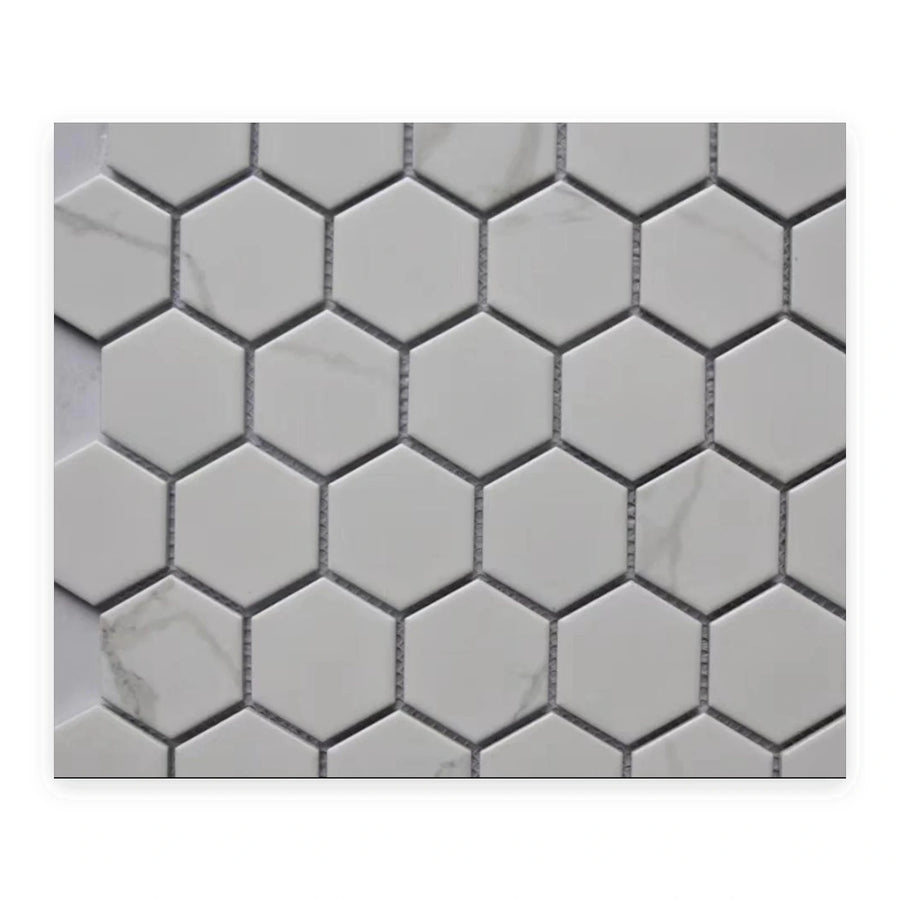
The product photograph helps you recognise the design. It does not turn the missing piece entry into a number. Enlarging the image on a screen changes the apparent size without adding a physical reference.
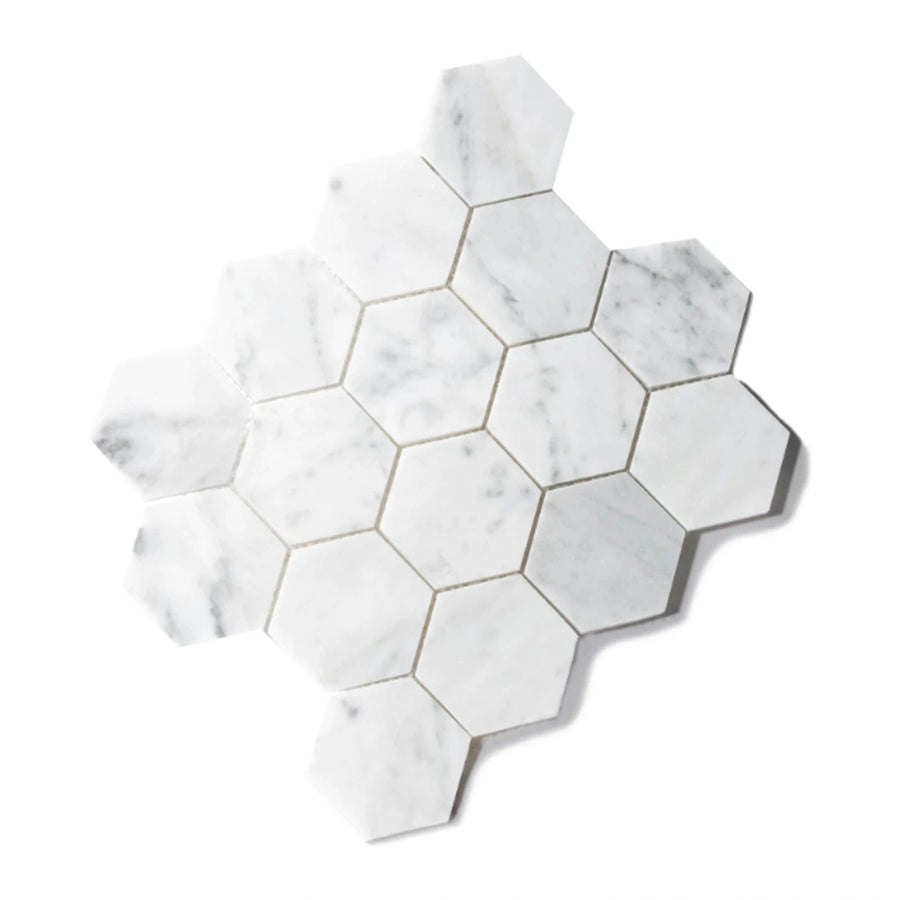
3. Large in the name does not mean a larger sheet
Carrara Large Hexagon has the smaller recorded sheet dimensions of the pair: 250 × 290 mm against 282 × 325 mm. Large in its name refers to the piece, not to an assertion that its sheet is larger.
The description calls it a larger 70 mm face. That supplies the context for the name, but it does not supply the missing piece size of Carrara Hexagon. There is no supported numerical comparison of the two individual hexagons to make from these records.
There is another gap inside the recorded 70 mm itself. The page does not say whether that dimension runs between opposite flat sides or opposite corners. Those are different ways of spanning a hexagon. It does not label the number as a side length either.
Consequently, 70 mm hexagon is the wording to retain. Replacing it with 70 × 70 mm would add a second dimension the supplier record does not give. Drawing a dimension arrow across a diagram would also choose a measurement direction that the page leaves open.
A sample can provide the physical object for a closer look, while the supplier's dimensional information can resolve what its specification means. Until that direction is stated, comparing the 70 mm entry with a differently labelled size elsewhere remains an incomplete comparison.
4. The search summary does not contain these two sheets
Google's Australian summary groups hexagon tiles into small mosaics, medium individual pieces and large-format examples. It describes small mosaic pieces in a 23–48 mm band and sheets around 260 × 300 to 305 × 305 mm. Those are the summary's examples, not specifications for the two products here.
The 70 mm piece record is above that quoted small-piece band. That does not convert Carrara Large Hexagon into an individual large-format tile: the product still records a mosaic sheet. A search category and the form in which a product is supplied are different pieces of information.
| Product record | Comparison with the summary's sheet range |
|---|---|
| 250 × 290 mm | Both dimensions are below the stated lower pair of 260 × 300 mm. |
| 282 × 325 mm | The first dimension falls within the stated span; 325 mm exceeds the 305 mm upper dimension. |
Neither sheet falls wholly within that stated range. One is smaller in both dimensions; the other is longer in one. This does not make either product exceptional or incorrect. It demonstrates why a general search summary cannot replace the individual Sheet size entry.
Australian collection-page snippets also list 75 × 75, 140 × 160 and 95 × 110 mm formats, plus elongated examples at 65 × 330 and 55 × 195 mm. These are examples from other listings. Their appearance in a search does not establish an equivalent product here or settle how a dimension was taken.
The collection here contains only two products, both recorded as White. There are no coloured hexagon products in it, and no individual large hexagon tile above 100 mm. The word Large in the mosaic's name does not extend that product offering.
5. What remains open when the size is known
Both products leave slip classification unrecorded; thickness reads 6 mm on Carrara Hexagon and 8 mm on Carrara Large Hexagon. Knowing a sheet's length and width does not answer the slip question, and knowing that the shape is hexagonal does not settle where the product can be used.
For Carrara Hexagon, the missing piece size is especially relevant to a visual comparison. The sheet dimensions describe the sheet as a whole; they do not say how large each repeat is. A sample lets you see the actual piece instead of filling that gap with an estimate from a photograph.
For Carrara Large Hexagon, the open question is more specific: what does its stated piece dimension span? Keep that question with the 70 mm entry. A precise number and an incomplete definition can coexist on the same product record.
The collection description discusses the interrupted joint lines of the pattern and its perimeter geometry. Those observations are not a size specification or a set-out plan. This page does not turn them into instructions for starting, cutting or laying a particular installation.
The existing kitchen hexagon guide covers layouts and gives nominal sheet-count comparisons of 10.9 and 13.8 sheets per square metre for these two sheet sizes respectively. Those are that guide's arithmetic examples, not additional dimensions supplied by a product record; this page does not recalculate them or turn them into order quantities.
Tile sizes in Australia handles the wider distinction between pieces and sheets. Keeping that distinction in view is enough here: a missing piece size stays missing, even when the sheet size is known.
6. Questions about the wording
What are the hexagon tiles called?
Hexagon, hex and honeycomb all appear as names for the shape. The two products here are hexagon mosaics. Their full product names separate the records, while Sheet size and Piece size tell you which part of the mosaic each dimension describes.
Is a 70 mm hexagon a 70 mm sheet?
No. The product records 70 mm hexagon as its Piece size and 250 × 290 mm as its Sheet size. The piece dimension's direction is not stated. Neither entry is a reason to replace the other, and neither supplies the missing piece size on Carrara Hexagon.
Can I work out the smaller piece from its sheet size?
Not from the information recorded here. A sheet size alone does not state the piece dimensions. Reading an assumed piece size into the row would make the table more complete on paper, but would not add a fact about the product.
What are fish scale tiles?
A mosaic whose pieces are rounded at one end so that, laid one way, the curves overlap the way scales do. This site keeps one: the fish scale collection holds a single product, recorded as Carrara Fan Mosaic Tile, with a sheet size of 225 × 230 mm and a piece figure of 75 mm. The same series' round sheet, 20 mm pieces on a 285 × 305 mm sheet, is read row by row in Penny round tiles: what the one sheet here records.
What is another name for fish scales?
Fan, at least here. The collection is titled fish scale and its one member is named Fan, so on this site the two words point at the same product — which is why searching either should find it. The product record itself uses Fan, and that is the name on the page you would order from.
7. Where these facts come from
The product records, collection description and Australian search results were read on 18 September 2026; the thickness entries were updated on 1 October 2026, and Carrara Large Hexagon's finish on 4 October 2026, from supplier documentation. The product table uses the two named descriptions and their material and colour tags. The market examples and size band come from the captured Google results for “hexagon tile sizes australia”, including its AI summary: https://www.google.com/search?q=hexagon+tile+sizes+australia&gl=au&hl=en-AU. Product images are the same catalogue images used by the existing kitchen hexagon guide.
For the questions a dimension cannot settle, read what to confirm before choosing. Keep the exact product name and each unrecorded field alongside the numbers you do have.
Search with Google? Add Tilekind as a preferred source and Google is more likely to show our guides in your Top stories.