
Every tile in this range states at least one dimension, and for most of them it is the size of the face you would see. This page sets those dimensions side by side — five field-tile formats and nine mosaic sheet sizes — and works out what each one does to one square metre of finished surface. Scale is the part of a tile that can be calculated from what is on file rather than judged from a picture; every count below was read from the collection and product pages on 28 August 2026.

Scale is the part a photograph does not carry
What to confirm before choosing sets out what a photograph loses on the colour side. Scale goes the same way for a different reason: a product shot is one unit or one sheet, and nothing in the frame fixes how large that unit is. The repeat has to be reconstructed rather than looked at.
What makes that possible is that a dimension is recorded, and a dimension multiplies. Fifty-nine of the sixty product pages state a face or sheet size in millimetres. The rest of this page is what happens when you multiply one.
Five field-tile formats and nine mosaic sheet sizes
Across the range the site states fourteen distinct face sizes. Five are field-tile formats: 75 × 300 mm, 100 × 300 mm, 300 × 600 mm, 600 × 600 mm and 600 × 1200 mm. The other nine are mosaic sheet sizes, and by area they all fall between 225 × 230 mm and 306 × 306 mm.
As at 28 August 2026, nineteen tiles are made at 300 × 600 mm, thirty-four at 600 × 600 mm, twelve at 600 × 1200 mm and nine at 75 × 300 mm. Each of those pages states its own count, and other collection pages already name two or three formats side by side.
What none of them does is turn a format into an area. The largest field format is thirty-two times the area of the smallest: 75 × 300 mm is 0.0225 m², 600 × 1200 mm is 0.72 m².
Two tiles are made at 100 × 300 mm — Studio Chalk and Studio Linen — and the site has no collection for that format. The subway tiles page gives the split, eleven in all: nine at 75 × 300 mm, two at 100 × 300 mm.
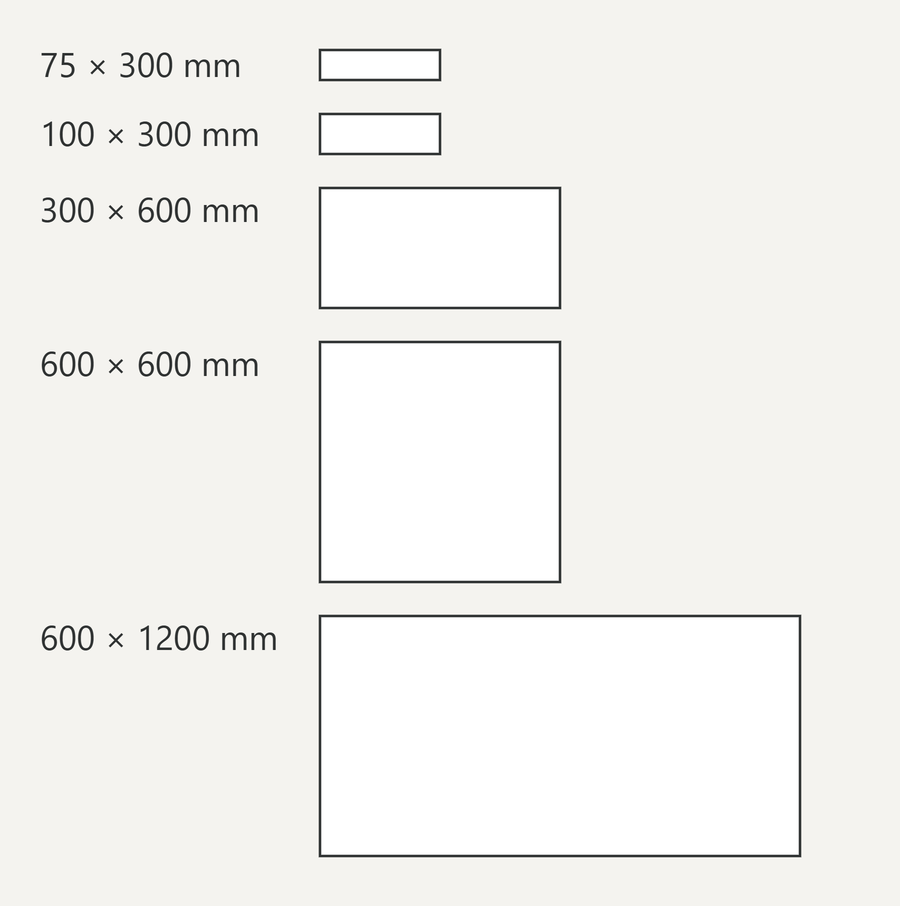
One square metre, counted in units
One unit multiplied until it fills a surface is a single division on paper. With no allowance made for joints, one square metre holds:
- 44.4 tiles at 75 × 300 mm;
- 33.3 at 100 × 300 mm;
- between 10.7 and 19.3 mosaic sheets;
- 5.6 tiles at 300 × 600 mm;
- 2.8 at 600 × 600 mm;
- 1.4 at 600 × 1200 mm.
These are gross figures, with no allowance for joints or cuts: a way of picturing a surface, not a quantity to order against — How to measure a tiling project covers that side. The 300 × 600 mm page takes the same count further, into what it means for the joints; this page stops at the units.
What a tiled surface asks you to clean takes the same count further still, into the length of joint each format holds.
For a mosaic the thing that repeats is not the sheet. The white tiles page already runs its range from 12.8 × 95 mm fingers to 600 × 1200 mm formats; put those ends into one division and a single 600 × 1200 mm tile covers the gross area of 592 fingers. That is the narrowest piece stated here, though not the smallest by area — one sheet is made of 20 mm rounds.
Twenty-eight tiles are made in two formats, and none in three
Twenty-eight tiles belong to two of the four size collections: eighteen pair 300 × 600 mm with 600 × 600 mm, and ten pair 600 × 600 mm with 600 × 1200 mm. No tile pairs 300 × 600 mm with 600 × 1200 mm, and none of the nine at 75 × 300 mm is made in a second format.
Twenty-eight is de-duplicated, taken from the sixty product records rather than by adding eighteen and ten, because adding collection counts double-counts anything sitting in three of them. Nothing sits in three.
The 600 × 1200 mm collection now holds twelve tiles. Ten of them are also made as a 600 mm square; Pietra Vela and Pietra Vela Fluted are made at 600 × 1200 mm and nothing else, so the long format is no longer always a second size for a tile you can also have as a square.
Two of the twelve longest tiles are not in large format tiles
As at 28 August 2026 large format tiles lists twelve and 600 × 1200 mm tiles lists twelve. The two lists are not the same twelve: Pietra Vela and Pietra Vela Fluted are made at 600 × 1200 mm and are in both, while the large format page also carries tiles whose second format is the square. That page says its grouping follows recorded tile dimensions, so where the question is a dimension, take it from the size collection.
Eleven sheets state a sheet size; the twelfth states a piece size
As at 28 August 2026 mosaic tiles lists twelve. Eleven state a Sheet size, falling on nine distinct specifications — 316 × 277 mm and 296 × 299 mm each appear on two products.
The measuring guide already warns not to assume one design shares a sheet size with the next. The size of that variation is 1.81 to one: 225 × 230 mm on Carrara Fan Mosaic Tile up to 306 × 306 mm on Carrara Square Mosaic Tile. Other pages quote a narrower span for their own smaller sets, so read any such range with the set it was measured over.
Largest by area is not longest. The longest single edge among the eleven is 325 mm, on Carrara Hexagon Mosaic Tile at 282 × 325 mm, which ranks third by area. Wherever this page names a largest or a smallest sheet, it means by area.
The twelfth is Studio White Finger Mosaic Tile. Its Specifications panel states Piece size: 12.8 × 95 mm and a finish, and no sheet size; the size row reads Check current size rather than a measurement. It is the one product in the range whose overall dimensions are not on the page.
Nine mosaics state both a sheet size and a piece size
Ten products state a Piece size and eleven state a Sheet size. Nine state both, and all nine are mosaics. A sheet size tells you how large the thing in your hand is. A piece size tells you how large the unit that repeats across the surface is. On a field tile those are one number, which is why only mosaics carry two.
Where both are stated and the piece is given in two dimensions, gross sheet area divided by gross piece area runs from 17.2 to 56.9, median 34.9. That is six of the nine; the other three state a piece in one dimension only — 20 mm, 75 mm, 70 mm hexagon — so no area can be taken from them. It is a ratio of areas with joints ignored, not a piece count. How to measure a tiling project points out that a box does not say how many sheets it holds. A sheet does not say how many pieces it holds either, and no product page in the range states one.
Browsing by size reaches forty-six tiles; reading the page reaches fifty-nine
Forty-eight products carry a tag beginning Size:, and for three of the four size collections that tag and the collection match exactly, product for product. The fourth does not. Not one of the nine tiles at 75 × 300 mm carries a Size: tag; they carry the bare dimension, 75 × 300 mm, and that collection is built on it. A tile can be outside the size system in the product data and still be browsable by size.
It runs the other way too. Two tiles carry 100 × 300 mm the same bare way and there is no collection for that format, and eleven mosaics carry a Size: tag while sitting in no size collection at all. Forty-six products sit in at least one size collection; fourteen sit in none — the twelve mosaics, plus the two at 100 × 300 mm. Browsing by size reaches forty-six of them, reading the product page reaches fifty-nine, and one product is in neither set: Studio White Finger Mosaic Tile carries no dimension tag and states no overall size.
Before you judge a tile on scale
Scale is settled on the product page, in this order:
- the face size — not one more row to check, but the unit that will repeat across the whole surface;
- for a mosaic, whether the page states a sheet size, a piece size or both — and which the size row is showing, since four mosaic pages put both numbers there and Carrara Petite Herringbone leads with the piece;
- whether the tile is made in a second format, since twenty-eight here are and the second format changes the count per square metre outright;
- whether the format you want can be browsed at all, since two tiles at 100 × 300 mm sit in no size collection;
- the one size row that reads
Check current size, where the sheet dimension is not on file.
Every dimension above was read off a product page on 28 August 2026, and every count off a collection or product page on the same date. A measurement is not a recommendation: no arithmetic here says whether a format suits a particular surface, or settles a layout. Check the size stated for the tile you have chosen, and confirm project requirements with the responsible installer or specifier before ordering.
Next step — read what the rest of the panel records. What to confirm before choosing works through the other rows in the same Specifications panel, and what each one leaves blank.
Where this guide sits: Where to start sets out the order the guides follow.