
Outdoor and balcony tiles in Melbourne weather: what to check on the product page
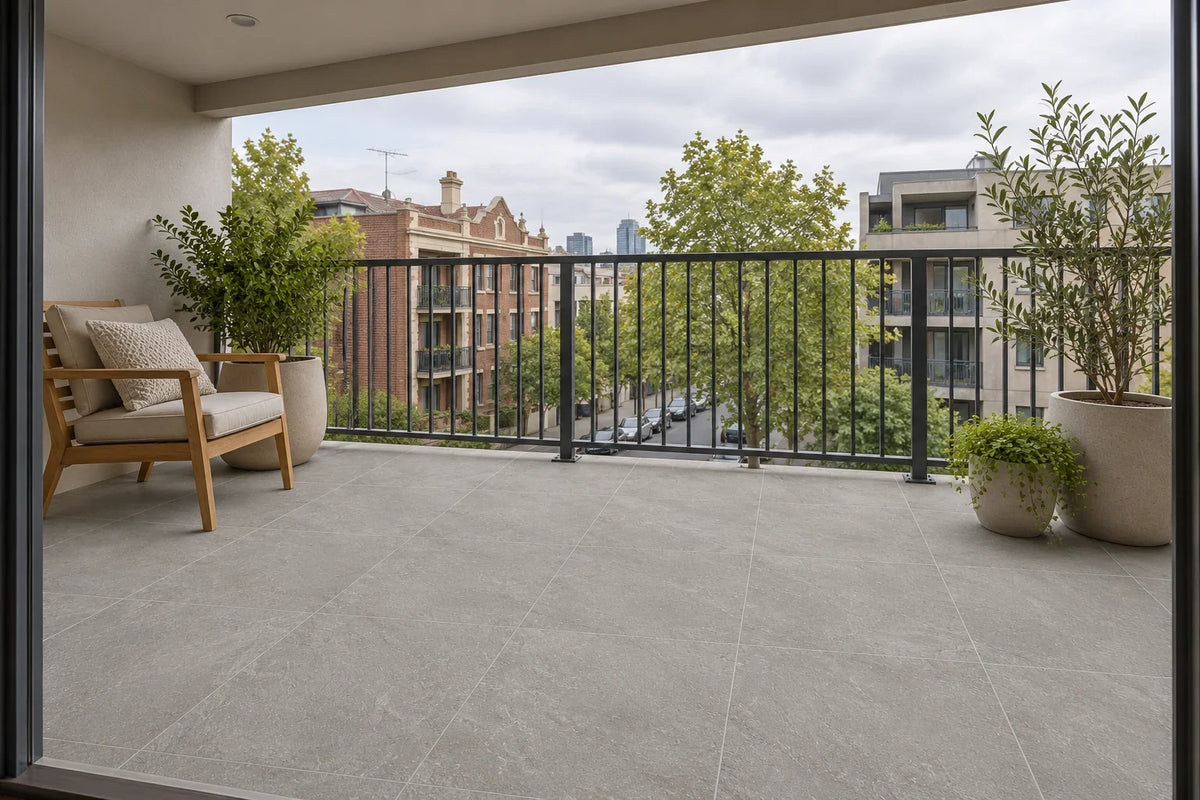
Short answer: the five tiles in the outdoor tiles collection here are all porcelain and 10 mm thick, and they are bonded tiles, not pavers. Their product pages record a slip class, a finish, sizes and a box coverage: the three Ridge slate looks record P5 and a rough face, and the two Haven terrazzo looks record P3, with a choice of matt or rough. What the pages do not record is whether a tile suits a particular balcony or courtyard; that depends on the falls, drainage and substrate, and it is for your tiler or specifier to confirm. Melbourne's weather is the reason to read those rows carefully: the Bureau of Meteorology's long record for the city counts about 100 days a year with at least 1 mm of rain.
This page sets out what that weather record says, which rows on a product page to read for an outdoor floor, and what the record leaves to the installer. For buying and delivery in the city, see tiles delivered in Melbourne.
1. Melbourne's weather on the Bureau of Meteorology record
The Bureau of Meteorology (BOM) publishes long-term averages for each weather station. Two Melbourne stations are useful: the old Melbourne Regional Office site, with records from the 1850s until it closed in 2015, and Melbourne (Olympic Park), open since 2013.
| BOM figure | Melbourne Regional Office (086071) | Melbourne (Olympic Park) (086338) |
|---|---|---|
| Years of record | Rain 1855–2015; temperature 1855–2014 | 2013–2026 (rain: 11 years) |
| Mean rainfall per year | 648.3 mm | 577.7 mm |
| Mean days per year with at least 1 mm of rain | 100.0 | 88.6 |
| Months with the most rain days | August and September (10.4 each) | October (9.7), then August (9.3) |
| Fewest rain days | February (5.1) | February (3.6) |
| Mean minimum temperature, July | 6.0 °C | 7.6 °C |
| Mean maximum temperature, January | 25.9 °C | 26.8 °C |
On either record, rain of at least 1 mm falls on roughly one day in four, and the wetter days are spread through winter and spring rather than packed into one season. An uncovered balcony or courtyard floor in Melbourne will be wet often, so the rows that describe the surface are the ones to read first.
2. Which rows to read on a product page
- Slip rating. The outdoor collection page says the class shown on each tile is the value in the supplier's current documentation; we do not hold the underlying test reports. The three Ridge tiles record P5 and the two Haven tiles P3. What the P classes mean, and what they do not tell you, is set out in tile slip ratings: what P3 means.
- Finish. The Ridge pages record a rough finish; the descriptions call it "a rough, cleft-stone face" on Ridge Grey and Ridge Slate. The Haven pages offer matt or rough as separate options, and each records a single slip class, P3, for the product rather than one for each finish. If the finish matters for your area, ask before ordering.
- Thickness. All five are 10 mm, which is a bonded thickness: they are laid onto a prepared substrate, not dry-laid on pedestals, sand or gravel. Tile thickness: 8 mm or 10 mm covers what the range records.
- Size. The Ridge tiles come in 300 × 600 mm and 600 × 600 mm; the Haven tiles in 600 × 600 mm only. Size sets how many joints the floor has.
- Colour. The Ridge tiles run from mid-grey to near-black; the Haven tiles are terrazzo looks with aggregate. Outdoor light is stronger and changes through the day, so judge colour on a sample outside.
3. The five tiles in the outdoor collection
Every figure below is from the product pages, read on 3 November 2026.
| Tile | How the page describes it | Sizes | Finish | Slip rating | Price per box |
|---|---|---|---|---|---|
| Ridge Grey | A mid-grey slate look with a rough, cleft-stone face | 300 × 600 mm, 600 × 600 mm | Rough | P5 | A$78 |
| Ridge Slate | A dark slate look with a rough, cleft-stone face and strong directional grain | 300 × 600 mm, 600 × 600 mm | Rough | P5 | A$78 |
| Ridge Charcoal | A near-black slate look with a rough face | 300 × 600 mm, 600 × 600 mm | Rough | P5 | A$78 |
| Haven In/Out | A terrazzo-look tile with matt and rough surface options | 600 × 600 mm | Matt or rough | P3 | A$75 |
| Haven Pebble In/Out | An oversized-aggregate terrazzo look with a rough face | 600 × 600 mm | Matt or rough | P3 | A$75 |
A 600 × 600 mm box holds 4 pieces covering 1.44 m² and weighs about 30 kg, so the price works out at A$54.17 per m² for the Ridge tiles and A$52.08 per m² for the Haven tiles. The Ridge 300 × 600 mm box is the same price, but its coverage is not stated on the pages. More on the two families: slate tiles or slate look and terrazzo-look tiles: 5 faces compared.
4. What the product record leaves to the installer
A product page describes the tile. It does not describe the place it goes. Falls and drainage, how the substrate is prepared, movement joints, and how hard the area gets used all sit outside the record, and no page here states a load classification. Those are questions for the tiler or specifier responsible for the job, and the answer can differ between two balconies in the same building.
5. Look at samples outside before ordering
Each of the five has a sample piece at A$3, up to five to a tray, with free sample delivery anywhere in Australia; the sample cost comes off a full-tile order of the same tile placed within six months. Order them on the samples page and look at them where the floor will be, on a dull day as well as a sunny one. Delivery rates by weight and state are on the delivery page; one 30 kg box costs A$35 within Greater Melbourne.
Questions people ask
How many rainy days does Melbourne get?
The Bureau of Meteorology's Melbourne Regional Office record (1855–2015) averages 100 days a year with at least 1 mm of rain. The newer Melbourne (Olympic Park) station, open since 2013, averages 88.6.
Which tiles here are in the outdoor collection?
Five: Ridge Grey, Ridge Slate and Ridge Charcoal, which record P5 and a rough finish, and Haven In/Out and Haven Pebble In/Out, which record P3 with matt or rough options. All five are porcelain and 10 mm thick.
Are these tiles pavers?
No. They are 10 mm bonded tiles, laid onto a prepared substrate. None is made for dry-laying on pedestals, sand or gravel.
Can I use these tiles on my balcony?
The product pages record the slip class, finish, thickness and sizes, not suitability for a particular balcony. Falls, drainage and the substrate decide that, so confirm it with your tiler or specifier.
What does P5 mean on the Ridge tiles?
P5 is a slip class taken from the supplier's current documentation; it is a higher class than P3. The slip ratings guide on this site explains the classes and their limits.
Where these facts come from
Weather figures are from the Bureau of Meteorology's climate statistics for Melbourne Regional Office (086071) and Melbourne (Olympic Park) (086338), read on 3 November 2026. Tile descriptions, sizes, finishes, slip classes, box coverage and prices are from the five product pages linked above, and the notes on thickness and test reports from the outdoor tiles collection page, read the same day. Prices can change; the product page shows the current price.
Search with Google? Add Tilekind as a preferred source and Google is more likely to show our guides in your Top stories.


