
Short answer: a terrazzo-look tile carries the pattern of terrazzo on a fired face; it is not poured terrazzo. The five on this site record a porcelain body and a matt face, in 300 × 600 and 600 × 600 mm, and two of them also record a rough face. The choice between them is chip scale, from fine grain to oversized, in white, grey or beige. Per square metre: about 5.6 tiles at 300 × 600 mm with 5.0 m of joint, or 2.8 tiles at 600 × 600 mm with 3.3 m.

| # | Product on this site | Sizes recorded | Finishes recorded | Colour | Chip reading (product page wording) |
|---|---|---|---|---|---|
| 1 | Haven Fine White Terrazzo-Look Tile | 300 × 600 mm / 600 × 600 mm | Matt | White | fine-grain |
| 2 | Haven White Terrazzo-Look Tile | 300 × 600 mm / 600 × 600 mm | Matt | White | subtle aggregate detail |
| 3 | Haven Grey Terrazzo-Look Tile | 300 × 600 mm / 600 × 600 mm | Matt | Grey | large pale aggregate |
| 4 | Haven In/Out Terrazzo-Look Tile | 600 × 600 mm | Matt, Rough | Beige | not described beyond the look |
| 5 | Haven Pebble In/Out Terrazzo-Look Tile | 600 × 600 mm | Matt, Rough | Grey | oversized aggregate |
1. Terrazzo and a terrazzo look are two different objects
Terrazzo is chips of stone or glass set in a cement or resin binder, poured or pre-cast and then ground flat, so every chip is a real piece and no two square metres repeat. A terrazzo-look tile is a fired tile whose face carries that pattern; the body under it is recorded here as porcelain. Two things follow. The pattern is made in a set number of face designs and repeats across the wall, and the surface is divided by a joint every 300 or 600 mm rather than running as one field. Neither is a fault; they are what the word look is telling you.
2. Chip scale is the personality
The five product pages describe their chips in their own words: fine-grain on Fine White, subtle aggregate detail on White, large pale aggregate on Grey, and oversized aggregate on Pebble In/Out. At arm's length a fine chip reads as a tone; from across a room an oversized chip reads as a pattern. The larger the chip, the more the joint competes with it, which is why chip scale and grout colour are one decision, not two.
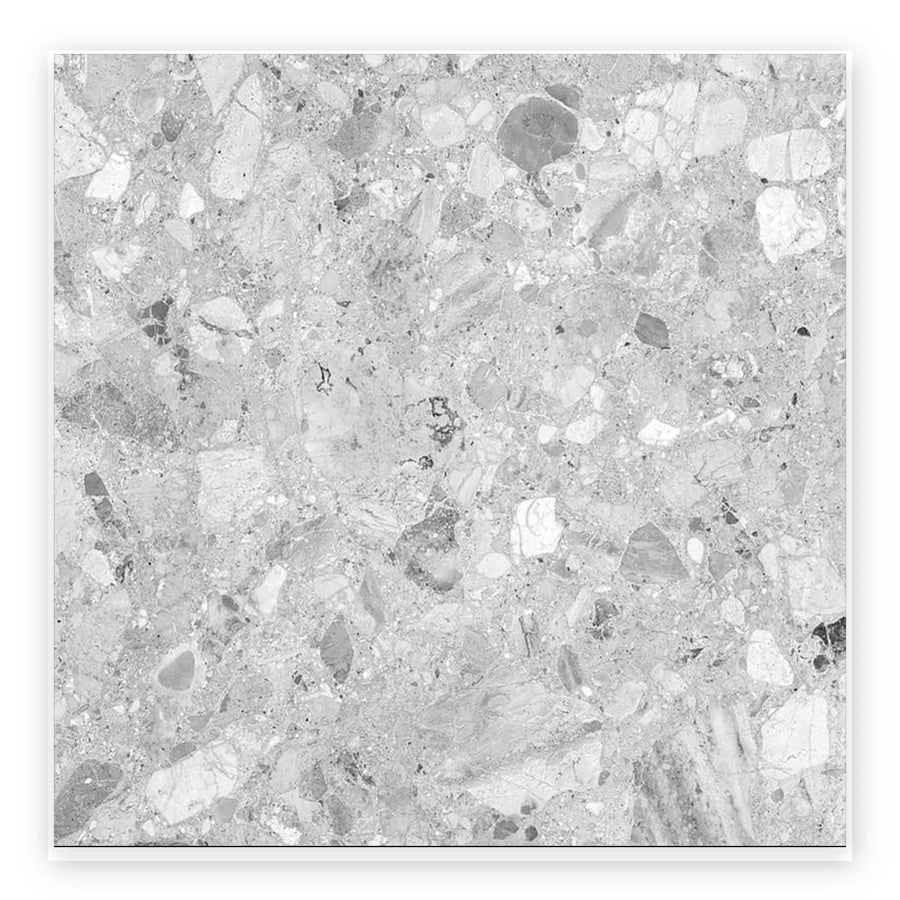
3. Two sizes, one grid
Three of the five are made in both 300 × 600 and 600 × 600 mm; In/Out and Pebble In/Out are made only as the square. The rectangle and the square share a 600 mm side, so they can meet on a common joint. Per square metre the rectangle is about 5.6 tiles and 5.0 m of joint, the square 2.8 tiles and 3.3 m. A square has one property a rectangle does not: every offcut fits the opposite side of the wall. The formats are listed under 300 × 600 mm tiles and 600 × 600 mm tiles.
4. Matt on all five, rough on two
Every product page in the group records a matt face. In/Out and Pebble In/Out also record a rough face, a textured surface with low points in it. Which face arrives is not a checkout option: the cart sells a purchase unit, standard or a sample piece, and the face options sit on the product page. The group sits under Matt finish tiles; the two textured faces also appear under Rough finish tiles.
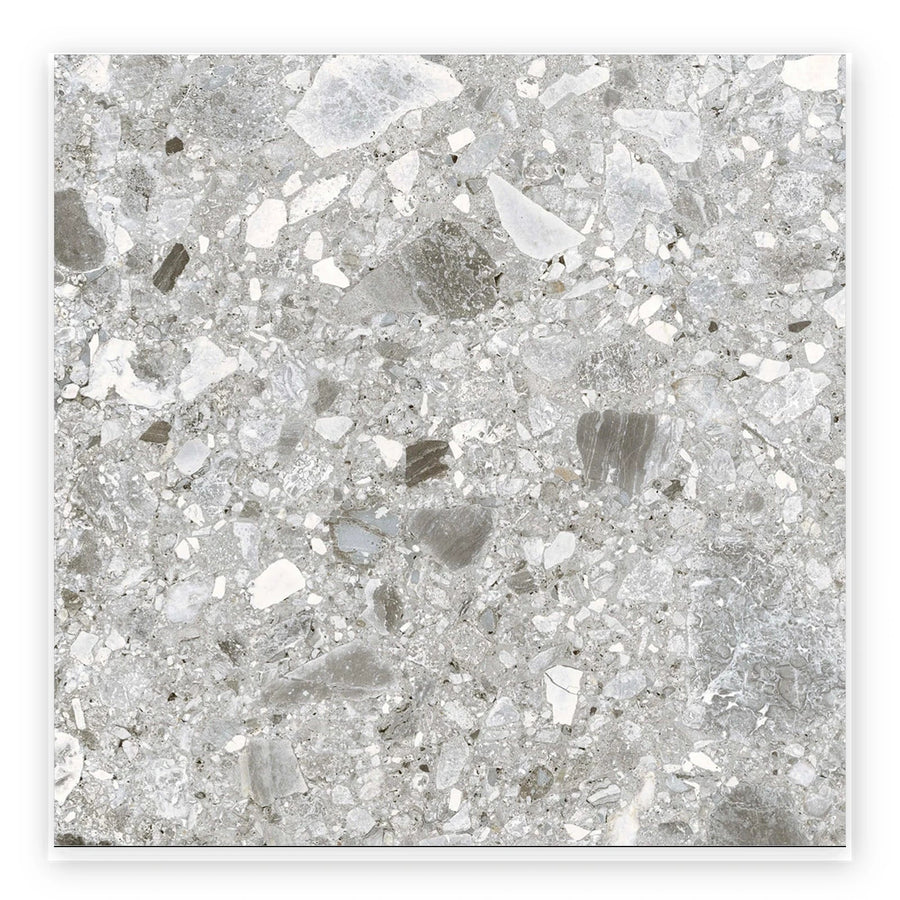
5. White, grey and beige
Fine White and White are the two white grounds, under White tiles. Grey and Pebble In/Out are the grey grounds, under Grey tiles. In/Out is the one beige ground, under Beige tiles. On a terrazzo look the ground colour and the chip colour are both part of the reading, so a white ground with pale chips and a white ground with grey chips are two different walls.
6. Grout with a terrazzo look
A grout matched to the ground colour lets the chips carry the pattern and the joints fall back. A contrasting grout draws the 300 or 600 mm grid over the chips, so the wall reads as tiles first and terrazzo second. Ask the tiler for a sample joint between two tiles before the wall goes up. Joint width is set by the installer and is not recorded on the product page.
7. A feature wall, counted
A wall 3 m wide and 2.4 m high is 7.2 m². Before cuts that is about 20 tiles and 24 m of joint at 600 × 600 mm, or 40 tiles and 36 m at 300 × 600 mm. Subtract openings from the net area first, then add the cutting allowance your tiler gives you. How to measure a tiling project sets out the method.
8. What the product pages record beyond size and face
Each of the five records a class on the AS 4586 scale and, where the supplier states one, a thickness. The values are the supplier's current documentation; this site does not hold the underlying test reports, and a recorded class is a reference value, not approval for a particular application. What is not recorded: the chip material, since the chips are part of the face, the number of face designs in a run, and care or sealing. What to confirm before choosing lists which rows each product page fills and which it leaves blank.
9. If the question is really about the floor
Many people searching for terrazzo tiles mean a floor. This page compares faces, sizes and joints; it does not settle where a tile belongs. That answer starts with the rows on the product page, the recorded class and thickness, and ends with the installer or specifier responsible for the project.
Questions people ask
Are terrazzo-look tiles real terrazzo?
No. Terrazzo is chips in a binder, ground flat. A terrazzo-look tile is a fired tile with that pattern on its face; here the body is recorded as porcelain.
How many 600 × 600 terrazzo-look tiles per square metre?
About 2.8, nominal, with no joint; about 5.6 at 300 × 600 mm. Multiply by net area and add the cutting allowance your tiler confirms.
Which terrazzo-look tile here has the biggest chips?
Pebble In/Out records an oversized aggregate; Grey records a large pale aggregate; Fine White is the smallest grain. Those are the product pages' descriptions, and a current sample is the way to check them against each other.
Should I pick the grout from the chart?
No. On a terrazzo look the grout either lets the chips carry the pattern or draws a 600 mm grid over them, and the difference only shows dried, on your tile; ask for a sample joint between two tiles. Grout colour: why a dried sample joint beats the chart explains why the chart misleads.
Where these numbers come from
Sizes, faces, colours, material and chip descriptions were read from the five product pages on 5 September 2026. Tiles per square metre are nominal counts with no joint; joint length is the total edge length in one square metre. All five are listed under Terrazzo look tiles and Porcelain tiles. Related guides: The five tiles here that are actually stone, How to compare tile scale and What a tiled surface asks you to clean.


