
Slate look floor tiles: indoor and outdoor, size, colour and grout
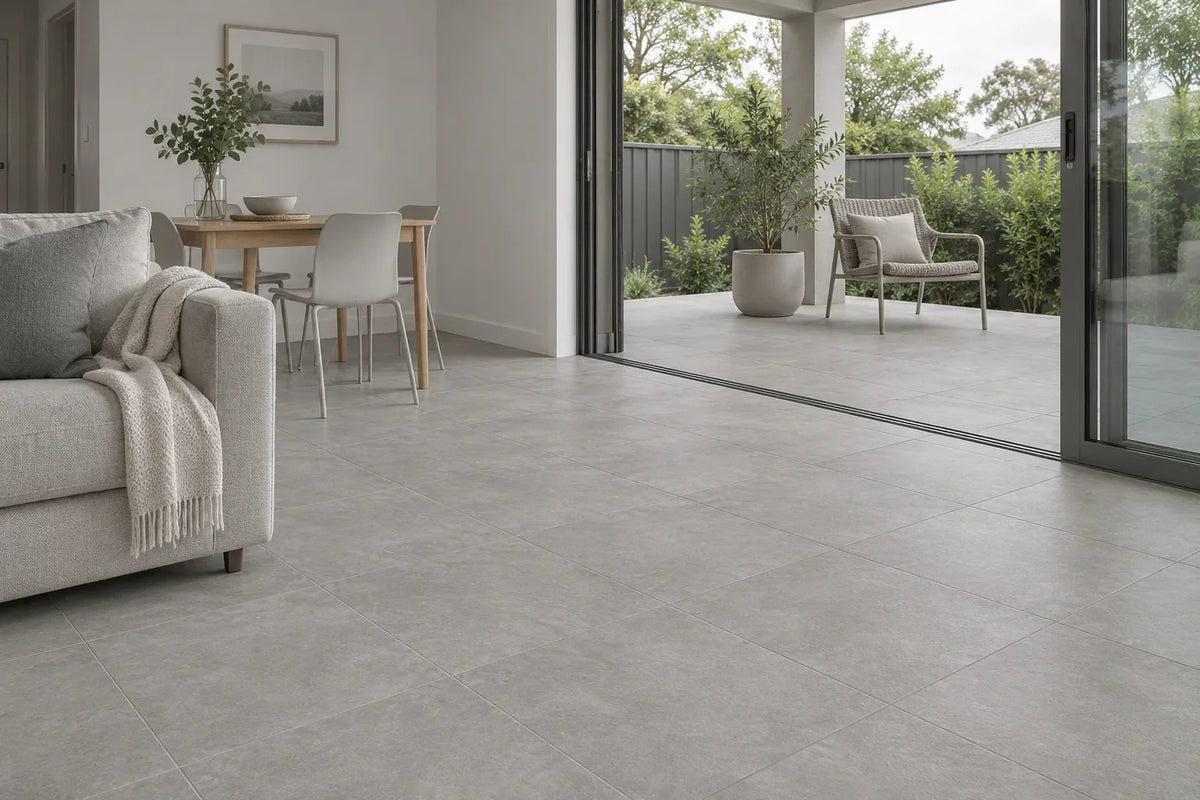
Short answer: slate floor tiles here are porcelain slate looks, the three Ridge tiles: Ridge Grey (mid-grey), Ridge Slate (dark, with a directional grain) and Ridge Charcoal (near-black). All three record a rough face, 10 mm, a P5 slip class and two sizes, 600 × 600 mm and 300 × 600 mm. Choose the colour first, then the size: 600 × 600 mm gives a floor with fewer joints, 300 × 600 mm gives a longer, plank-like rhythm. The same tile can run from an inside floor to a covered outdoor area, which is the main reason people pick one tile for both; whether it suits a particular outdoor floor is for your tiler to confirm.
1. Where a slate look floor goes inside the house
A slate look reads as a hard-working stone floor, so it is usually chosen for the rooms that take the most traffic:
- Entry and hallway: the first floor you walk on, where a mid or dark grey tends to show everyday marks less than a pale floor.
- Kitchen, dining and living: one floor across an open-plan area, often running to the back door.
- Laundry and mudroom: a practical floor next to the outside.
Whatever the room, read the rows on the product page rather than the name: the tiles are porcelain, not split slate, as Slate tiles or slate look? explains.
2. One tile inside and out
Running the same tile from the living room through the sliding door to a covered alfresco makes the two areas read as one. The three Ridge tiles are also the slate looks in outdoor tiles, so the indoor and outdoor floors can be the same colour, size and face.
The product pages describe the tile, not the place it goes. Falls and drainage, the substrate, the step or threshold at the door and movement joints are for your tiler to settle, and the page asks you to confirm the slip class for the intended area. Outdoor and balcony tiles in Melbourne weather covers the rows to read for the outside part.
3. 600 × 600 or 300 × 600 mm: how the floor looks
Both sizes are on each Ridge product page, so the choice is about the pattern and the number of joints, not the tile:
| Size | Tiles per m², no joints | Joint length per m² | How the floor reads |
|---|---|---|---|
| 600 × 600 mm | 2.78 | 3.3 m | A calm grid of squares; fewer joints to see and clean |
| 300 × 600 mm | 5.56 | 5.0 m | A plank-like rhythm, often laid in a brick or third offset |
The joint figures are length only, worked from the tile size; the joint width is set by your tiler. In a narrow hallway the long side of a 300 × 600 mm tile run along the hall makes the space read longer; in a large open-plan room 600 × 600 mm keeps the floor quieter.

4. Three colours: mid-grey, dark grey, near-black
| Tile | How the product page describes it | Pairs easily with |
|---|---|---|
| Ridge Grey | A mid-grey slate look with a rough, cleft-stone face | White walls, pale timber, most kitchens |
| Ridge Slate | A dark slate look with a rough, cleft-stone face and strong directional grain | Warm timber, black fittings; the grain gives the floor movement |
| Ridge Charcoal | A near-black slate look with a rough face | White or light grey walls for strong contrast |
Colour on a screen is not colour on a floor, and a rough face looks different in raking light. Put samples of two or three on the floor where they will go, look in daylight and at night, and step back. More grey floors are compared in Grey tiles: 17 faces compared, and all six stone looks are in stone look tiles.

5. Grout colour on a slate look floor
A grout close to the tile colour lets the floor read as one surface; a lighter grout draws the grid, and on a dark floor a pale joint shows every line. Most slate look floors use a mid or dark grey joint. Judge it from a dried sample joint, not a chart: Does grout dry lighter or darker? explains why.
6. How many boxes
A 600 × 600 mm box of any Ridge tile holds 4 tiles and covers 1.44 m². As an assumed example, a 20 m² open-plan floor is 13.9 boxes before any allowance, so 14; with an assumed 10 per cent allowance, 22 m², it is 16 boxes. Agree the allowance with your tiler, and check the box coverage for 300 × 600 mm on the product page before ordering that size. The tile calculator turns your own measurements into whole boxes.
Questions people ask
Are these slate floor tiles real slate?
No. The three Ridge tiles record porcelain as their material; they are made to look like slate. No tile on this site records slate as its material.
Can I use the same slate look tile inside and outside?
The three Ridge tiles are in both the indoor ranges and the outdoor tiles collection, so the same tile can be chosen for both. Whether it suits your outdoor floor, and how it is laid there, is for your tiler to confirm against the product's recorded slip class.
What size slate look floor tile should I choose?
600 × 600 mm gives 2.78 tiles and 3.3 m of joint per square metre, a calm grid. 300 × 600 mm gives 5.56 tiles and 5.0 m of joint, a longer, plank-like look. Both sizes are offered on each Ridge tile.
What slip rating do the Ridge tiles record?
P5 on all three, as a reference figure from the supplier's documentation. The product page asks you to confirm it for the intended application with your certifier or installer.
What grout goes with a dark slate look floor?
Usually a mid or dark grey close to the tile colour, so the floor reads as one surface. A pale grout shows every joint. Choose it from a dried sample joint.
Where these facts come from
Material, colour description, finish, thickness, slip class, sizes and box contents come from the Ridge Grey, Ridge Slate and Ridge Charcoal product pages, read on 11 November 2026. Tiles and joint length per square metre are worked from the stated tile size, with no joint width and no allowance. The 20 m² floor is an assumed example. This guide is about choosing and appearance; suitability for a particular floor and how it is installed are for your tiler to confirm.
Search with Google? Add Tilekind as a preferred source and Google is more likely to show our guides in your Top stories.


