
Bathroom feature wall tiles: which wall, where it stops, fluted or flat
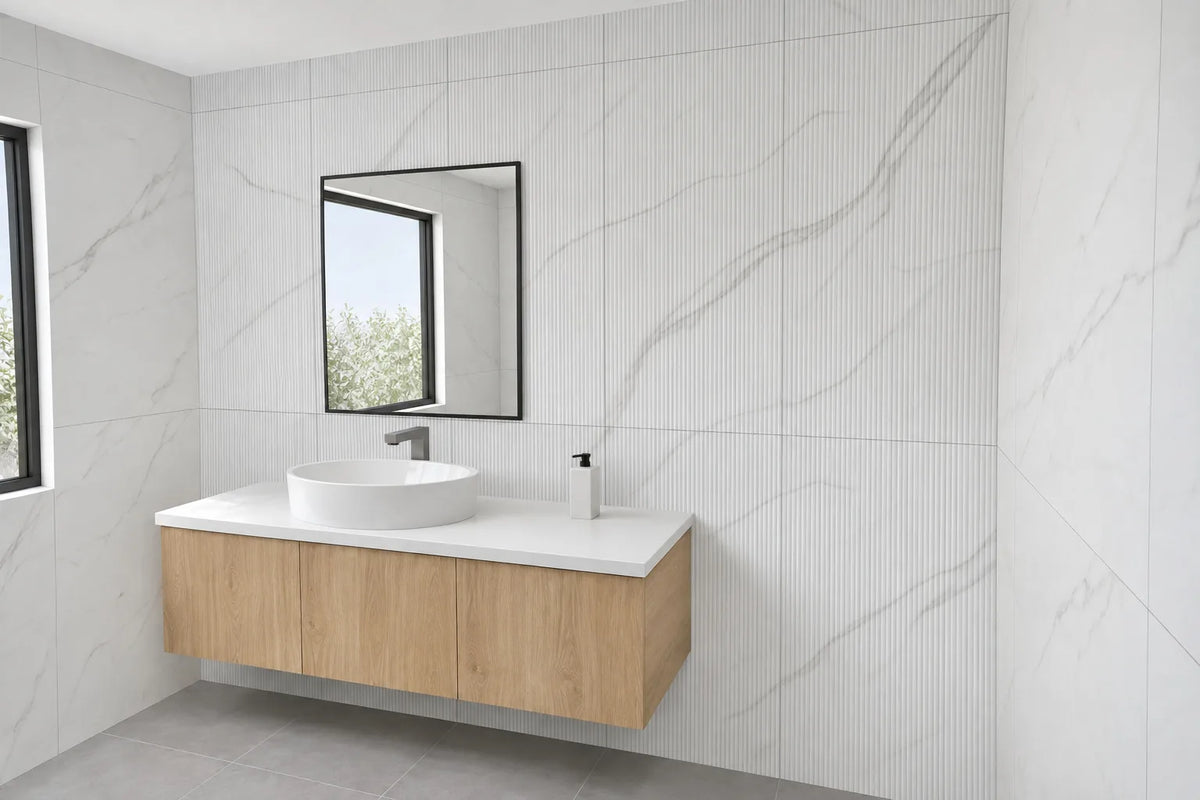
Short answer: a bathroom feature wall is usually the one wall you see first: behind the vanity, behind the bath, or facing the door. Tile it from the floor (or the benchtop) to the ceiling and stop it at an inside corner, so the change of tile happens on a clean vertical line. Then choose its face. A fluted tile such as Pietra Vela Fluted gives stripes of light and shade, a mosaic gives a fine pattern, and the same look in a flat tile, Pietra Vela, keeps the other walls quiet. Look at a sample in the room's own light before you order, because side light and ceiling light make a fluted face read very differently.
1. Which wall should be the feature wall?
Pick one wall, not two. The candidates in most Australian bathrooms are the same three:
- Behind the vanity. It is the wall you face every day, the mirror and the lights are already there, and it is often the shortest run of tile. Design guides that write about fluted tiles call it the most common placement.
- Behind the bath. A long, mostly unbroken wall, so the pattern reads as one piece.
- The wall you see from the door. In a small bathroom this is often one of the two above. If it is not, it can be the better choice, because it is the view people get without stepping in.
A wall with a window, a large mirror cabinet or several fittings in it breaks the surface into pieces, and a feature tile shows less there. For more examples of how one wall is set against plainer ones, see Feature wall tiles: 11 installed walls.
2. Where the feature wall stops
Where the feature tile stops is the decision people see every time they walk in. Three lines are common:
| Where it stops | What it looks like | What to settle with your tiler |
|---|---|---|
| At an inside corner, floor to ceiling | The cleanest change: one wall is the feature, the next wall is plain | Which tile is cut at the corner, and the joint colour on that line |
| At an outside corner | The edge of the tile shows | A trim or a mitred edge; the fluted tile guide sets out both |
| Partway along a wall | A vertical line in the middle of a surface | Line it up with something, such as the edge of the vanity or the bath, so it looks planned |
Height matters as well. Floor to ceiling reads as architecture; stopping at a set height, such as above the vanity top, reads as a splashback. If the room has a bulkhead or a sloping ceiling, the top edge follows it, so check where the top course will be cut before you order. Half wall or floor-to-ceiling tiling: what changes works through the area at each height.

3. Fluted, flat or mosaic: three ways to make one wall different
A feature wall can be different in its surface, its pattern or its colour. The tiles here offer the first two in one white marble look, so the room can keep one colour throughout:
| Feature | Tile here | What the product page records | How it changes the wall |
|---|---|---|---|
| Surface | Pietra Vela Fluted | Porcelain, 600 × 1200 mm, 10 mm, Profile: Fluted | Parallel channels; set upright, they run floor to ceiling |
| Pattern | Carrara Petite Herringbone | Natural marble, polished, 30 × 60 mm pieces on a 270 × 262 mm sheet | A fine zigzag; many joints, so the grout colour shows |
| Pattern | Carrara Stack | Natural marble, polished, 36 × 150 mm pieces on a 305 × 305 mm sheet | Narrow strips in straight lines |
| Plain partner | Pietra Vela | Porcelain, 600 × 1200 mm, 10 mm, Finish: Matt | The same white marble look, flat, for the walls around the feature |
Pietra Vela Fluted and Pietra Vela are the same size, material and thickness and come in the same box (2 pieces, 1.44 m²), so the fluted wall and the flat walls around it line up course for course. More white tiles are in white tiles, and the mosaics in mosaic tiles.
4. Light: why a fluted wall looks different at night
A fluted face is made by its shadows. Light that comes from the side, such as a window beside the wall or wall lights either side of a mirror, falls across the channels and leaves a stripe of shade in each one. Light from straight in front of the wall, or from a ceiling light well out into the room, fills the channels and the stripes fade. The same wall can look strongly lined in the morning and almost flat at night.
So look at the sample twice: once in daylight where the wall will be, and once in the evening with the bathroom's own lights on. Hold it upright, with the channels running the way they will on the wall. A flat tile or a mosaic changes much less between the two. Three tile samples, one evening sets out that test step by step.

5. The other walls, the floor and the grout
- Other walls: one quieter tile, ideally in the same colour as the feature. The flat Pietra Vela beside the fluted one is the simplest pairing here.
- Floor: a different look is fine, but keep it calmer than the feature wall, so there is one thing to look at.
- Grout: design guides that write about fluted tiles suggest a grout close to the tile colour, so the joints do not cut across the stripes. Choose it from a dried sample joint, as Does grout dry lighter or darker? explains.
Choosing the rest of the room? How to choose bathroom tiles takes it one decision at a time, and every tile here is in bathroom tiles.
6. How many tiles for one feature wall
Measure the wall's width and the height you will tile, and subtract anything that will not be tiled, such as a window. As an example, an assumed wall 1.8 m wide and 2.4 m high is 4.32 m². In Pietra Vela Fluted, set upright, that is three tiles across and two high, or three boxes before any allowance; with an assumed 10 per cent allowance it is four boxes. Agree the allowance with your tiler, because cuts around a vanity or a niche change it. The tile calculator turns your own measurements into whole boxes.
Questions people ask
Which wall should be the feature wall in a bathroom?
Usually one of three: the wall behind the vanity, the wall behind the bath, or the wall you see from the door. Pick one, and prefer a wall without a window or a large cabinet in it, so the feature tile is seen as one surface.
Should a bathroom feature wall go floor to ceiling?
Floor to ceiling, stopped at an inside corner, gives the cleanest edge. Stopping at a set height, such as above the vanity, reads more like a splashback. Check where the top row will be cut before you order.
What goes with a white fluted feature wall?
A flat tile in the same colour on the other walls, such as Pietra Vela beside Pietra Vela Fluted, and a grout close to the tile colour. The two are the same size and come in the same box, so they line up course for course.
Does a fluted wall look the same in every light?
No. Side light leaves a shadow in each channel and makes the stripes strong; light from the front fills the channels and the wall looks flatter. Look at a sample in daylight and again with the bathroom lights on.
How many boxes of tiles for a bathroom feature wall?
Divide the wall area by the coverage of one box and round up. An assumed 1.8 × 2.4 m wall is 4.32 m², which is three boxes of a 600 × 1200 mm tile at 1.44 m² a box, or four with a 10 per cent allowance.
Where these facts come from
Sizes, materials, thickness, profile, finish and box contents come from the product pages for Pietra Vela Fluted, Pietra Vela, Carrara Petite Herringbone and Carrara Stack, read on 11 November 2026. The placements and grout advice for fluted walls are those quoted, with their sources, in Fluted tiles: what they are and how they are laid. The wall in section 6 is an assumed example, not a measurement of any room. This guide is about appearance and planning; what a tile is suitable for in your bathroom, and how it is installed, is for your tiler to confirm.
Search with Google? Add Tilekind as a preferred source and Google is more likely to show our guides in your Top stories.


