
Short answer: a sample is one piece from one batch, looked at in your light. It can settle colour, face and edge; it cannot settle the batch you will receive, the full face variation of a look tile, or how a whole wall reads from across the room. Every product page on this site lists a sample piece, and every one carries the same line: shade and surface vary between production batches, so look at a current sample before final selection. This guide is what to do with it once it is on your bench.

| What a sample piece shows | What it cannot show |
|---|---|
| Colour under your own daylight and your own lamps | The batch your order will come from |
| The face: gloss, matt, honed, polished, soft polished, fluted, rough | How many different faces a look tile is made in |
| Texture you can feel, and how the face takes a fingerprint or a water drop | How the field reads at three metres, with its joints |
| The edge: rectified or pillowed; the thickness where the page records one | The grout, which is a separate decision |
| How it sits against your benchtop, cabinet door, paint and tapware | Whether the tile belongs on a given surface; that is a product-record and installer question |
1. A sample is one piece, and the product page says so
All sixty products here list a sample piece alongside the standard purchase unit, and all sixty product pages carry the batch line. That is not small print; it is the reason to have the sample at all. Treat it as evidence about the tile design and the current batch, not as a promise about the batch that arrives later. Tile samples explains how sample pieces are ordered.
2. Look at it where it will live, standing up
Hold the sample vertical against the wall it is for, not flat on the table. Wall tiles are seen upright and lit from the side; a piece lying flat under a ceiling light is a different object. Look at it in the morning and again in the evening, and under the room's own lights, because a cool white in south light and the same tile under a warm globe are two colours. A tile bought for a north-facing room and viewed only in the shop is the most common way a white turns out cold.
3. Two samples beat one, and the neighbours matter more
The mismatch people notice after tiling is rarely the tile against a photo; it is the tile against the cabinet door, the benchtop and the floor already in the room. Put the sample against each of them in turn. If two whites are in the running, look at them side by side, not on different days; the eye keeps no memory of a shade. One forum poster found a splashback whiter and colder than the sample had suggested against warm doors and a warm benchtop; the sample was right, the comparison was missing.
4. A look tile has more faces than your sample
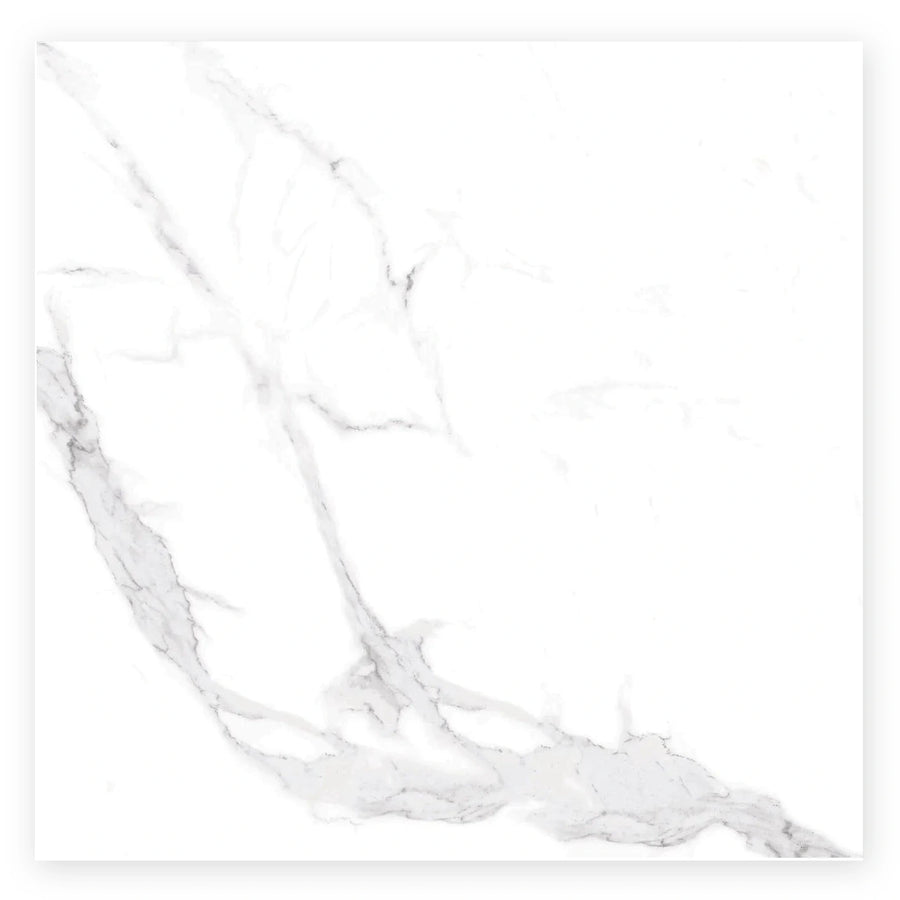
A marble-look or terrazzo-look tile carries its figure on a printed face, and a design is made in a set of different faces so that a wall does not repeat obviously. The product pages here do not record how many faces a design has. Your sample is one of them. Ask to see several pieces side by side, or several photographs of full tiles, before deciding that the figure is quiet or busy. Marble-look tiles: 14 faces compared and Terrazzo-look tiles: 5 faces compared list what each product records.
5. Gloss, matt and honed change with the angle
Tilt the sample. A gloss face returns the window as a reflection at one angle and reads flat at another; matt and honed diffuse light and hold their colour as you move. Soft polished sits between. A splashback is seen at a steep angle from the benchtop and a wall tile at eye level, so tilt the piece to the angle it will actually be seen at. The thirteen ways this range writes a finish lists the faces recorded here.
6. Edges and thickness
Look at the edge. A rectified edge is cut square after firing and lets the joint run narrow; a glazed, slightly pillowed edge softens the joint and reads as a grid of small cushions. On this site rectified is recorded on one product's page and thickness on fourteen of the twenty-nine white tiles, at 8 mm or 10 mm; where the page records neither, the sample is the only place to see them. Two white tiles that look the same goes through those rows.
7. The batch line, and what to do with it
The line on every product page here says shade and surface vary between batches. In practice that means three things: the sample's batch is not necessarily the order's batch; the tiles that arrive should be compared with the sample before they go on the wall; and any later top-up may be a different batch again. Keep the sample until the job is finished. Your rights when tiles arrive wrong covers the case where what arrives is not what was ordered.
8. Write it down before you order
On the back of the sample or on the order record: the product name and the size you chose where the page lists two; the face you chose where the page lists two; the colour name; what you compared it against and in which light; and the grout colour, once the dried sample joint exists. Grout colour: why a dried sample joint beats the chart is the next step, and What to confirm before choosing lists the product-page rows to check at the same time.
Questions people ask
How many samples should I get?
Every serious candidate, and at least two whites if a white is in the running, because a white on its own has no reference. Look at them together, upright, in the room.
Is the sample from the same batch as my order?
The product pages do not promise that, and the batch line says the opposite can happen. Compare the delivered tiles with the sample before installation.
What should I compare a sample against?
The surfaces already in the room: benchtop, cabinet doors, floor, paint, tapware. The tile is judged next to them, not next to a photograph.
Where these facts come from
The sample-piece listing, the batch line, the thickness and rectified rows were read from the product pages on 5 September 2026. Nothing here is a performance claim; how a face handles light is what the recorded finish names describe. All whites are listed under White tiles; greys, beiges and the one green under Grey tiles, Beige tiles and Green tiles.